Biggest waterfalls in Iceland
Tallest, most powerful, blackest — ranked from recorded heights, with the widely quoted numbers that do not agree with each other flagged rather than tidied away.
Iceland’s tallest waterfall is Morsárfoss at 240 m, in Vatnajökull National Park. Glymur is second at 198 m. “Biggest” splits three ways after that: Dettifoss is the one usually called Europe’s most powerful — Wikipedia says second, after the Rhine Falls — and Gullfoss is the one claimed to be Europe’s biggest by volume, a claim we cannot back with a measurement of our own. The table below ranks 23 falls by the height our data actually records.
| Rank | Waterfall | Height | Region | Source |
|---|---|---|---|---|
| 1 | Morsárfoss | 240 m | South Coast | Wikipedia |
| 2 | Glymur | 198 m | West Iceland | Wikipedia |
| 3 | Hengifoss | 128 m | East Iceland | Wikipedia |
| 4 | Háifoss | 122 m | Highlands | Wikipedia |
| 5 | Dynjandi | 100 m | Westfjords | Wikipedia |
| 6 | Fagrifoss | 80 m | South Coast | Wikipedia |
| 7 | Skógafoss | 60 m | South Coast | Wikipedia |
| 8 | Seljalandsfoss | 60 m | South Coast | Wikipedia |
| 9 | Gluggafoss | 47 m | South Coast | Wikipedia |
| 10 | Dettifoss | 44 m | North Iceland | Wikipedia |
| 11 | Gljúfrabúi | 40 m | South Coast | Wikipedia |
| 12 | Gullfoss | 32 m | South Coast | Wikipedia |
| 13 | Kvernufoss | 30 m | South Coast | Wikipedia |
| 14 | Litlanesfoss | 30 m | East Iceland | Wikipedia |
| 15 | Hafragilsfoss | 27 m | North Iceland | Wikipedia |
| 16 | Aldeyjarfoss | 20 m | North Iceland | Wikipedia |
| 17 | Öxarárfoss | 20 m | Reykjavík Area | Wikipedia |
| 18 | Svartifoss | 20 m | South Coast | Wikipedia |
| 19 | Goðafoss | 12 m | North Iceland | Wikipedia |
| 20 | Barnafoss | 10 m | West Iceland | OSM / natt.is |
| 21 | Selfoss | 10 m | North Iceland | OSM / natt.is |
| 22 | Urriðafoss | 6 m | South Coast | Wikipedia |
| 23 | Kirkjufellsfoss | 5 m | West Iceland | OSM / natt.is |
This is a ranking of falls whose height our sources actually publish — 48 of the 425 we map carry a number at all, and this table lists the ones we have checked against their real coordinates. It is not a claim that no taller unnamed drop exists in Iceland; there almost certainly is one, in a canyon nobody has measured. Where a guide elsewhere ranks fifty falls by height, ask where the fifty numbers came from.
Heights come from OpenStreetMap, Wikidata and natt.is via our waterfall dataset; the Wikipedia text quoted on this page is used under CC BY-SA and linked per row. A single figure for a waterfall is always a simplification — most of these drop in stages, and “total height” and “main drop” are different numbers.
| The claim | Waterfall | What our data holds | Where the claim comes from |
|---|---|---|---|
| Tallest in Iceland | Morsárfoss | 240 m | Wikipedia — "at least 240 metres (790 ft)". Travel guides commonly publish 227–228 m instead. |
| Second tallest | Glymur | 198 m | Wikipedia — held the title outright until Morsárfoss was measured in 2011. |
| Most powerful in Europe | Dettifoss | 44 m tall; no flow rate in our data | Contested. Wikipedia says second most powerful, after the Rhine Falls. Travel sites published 93 and 193 m³/s for it on the same day in July 2026. |
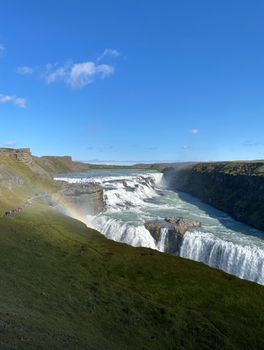
| Biggest in Europe by volume | Gullfoss | 32 m tall, in two drops; no flow rate in our data | A travel-publisher claim, not a measurement we hold. Widely repeated; we cannot show you the number behind it. |
| The black waterfall | Svartifoss | 20 m | The name: svarti = black. Framed by dark hexagonal basalt columns in Skaftafell. |
| Widest of the famous ones | Dynjandi | 100 m, fanning out as it drops | Its shape rather than a measurement — Dynjandi widens down the slope, which is why it photographs like a staircase. |
The reason this table exists: search “biggest waterfall in Europe” and you get confident, mutually contradictory answers. On one afternoon in July 2026 the top results published Dettifoss at both 93 and 193 cubic metres per second, and Morsárfoss at both 228 and 240 metres. Nobody shows their working. We hold no flow measurements, so we publish none as ours — and where our recorded height differs from the number a guidebook quotes, we say that rather than quietly matching them.
If you want the falls that feel biggest rather than the ones that measure biggest, the honest answer is Dettifoss for sheer force, Dynjandi for scale, Skógafoss for standing close enough to get soaked, and Gullfoss for the two-stage drop into the canyon. Sizes and how to reach each one are on the individual pages.
Where the tallest one is
Morsárfoss sits at the head of the Morsárdalur valley in Vatnajökull National Park — seen on foot from the Skaftafell side, not from a car park.
Frequently
asked questions
What is the tallest waterfall in Iceland?
Was Glymur the tallest waterfall in Iceland?
Is Dettifoss the most powerful waterfall in Europe?
What is the biggest waterfall in Europe by volume?
What is the black waterfall in Iceland?
How many waterfalls in Iceland have a published height?
Cars & campers
 KEF airport pickup 24/74.8
 Transmission
 Fuel
Fuel Seats
Seats Drive
Drive

 Sleeps
Tours near Iceland's waterfalls
 Small groups
 Duration
 Highlights
 Type
Type