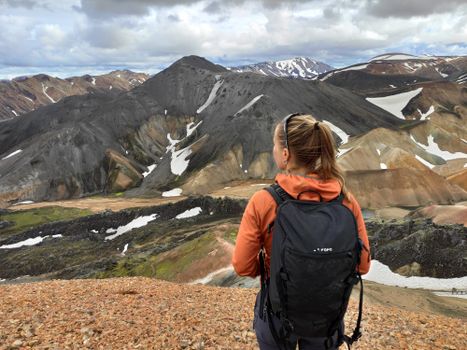
What Are F-Roads in Iceland?
The F is for fjall — mountain. Here's what F-roads are, why they need 4WD by law, the river-crossing rules, and how to check which are open right now.
F-roads are Iceland's Highland mountain roads. The F stands for fjall — Icelandic for mountain. They cross the interior, require a 4WD by law, open only in summer once cleared, and often include unbridged river crossings. A 2WD on an F-road is illegal and voids your insurance.
How many F-roads are open in Iceland right now?
2 of 40 F-roads tracked by umferdin.is are open right now and 7 are closed (31 not currently reporting). Per-road status is in the table below — always check conditions on the day you drive.
Data verified 16 October 2026, 07:39 · source: umferdin.is (Vegagerðin, the Icelandic Road Administration) · refreshes every 10 minutes
Ring Road (R1) slippery in placesHighlands: 56 of 64 monitored roads closed or impassableVegagerðin, updated just now
Where the F-roads are
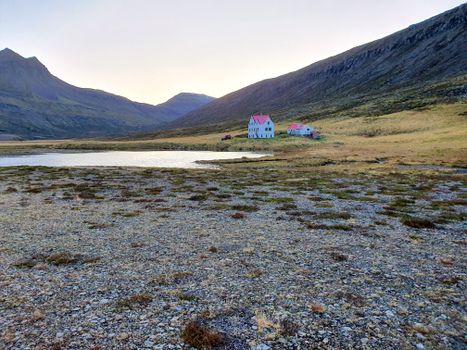
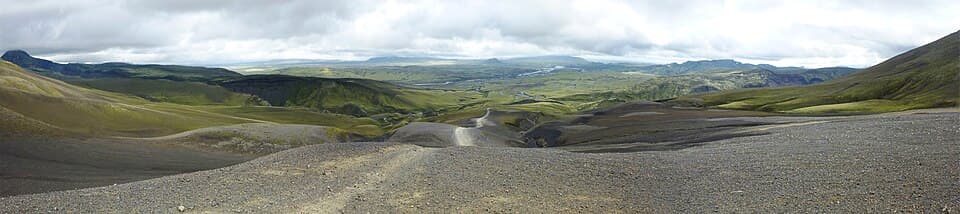
F-roads fill the interior Highlands — the empty middle of the country, ringed by the paved coast road. Open the map to see how the tarmac gives way to mountain track.
What an F-road actually is
An F-road is a Highland mountain road. The F prefix on the number — F35, F208, F26 and the rest — stands for fjall, the Icelandic word for mountain, and it marks a road that crosses the interior rather than skirting the coast. These are the routes into the empty middle of Iceland: Landmannalaugar, Þórsmörk, Askja, Sprengisandur. They are not paved, they are not graded like a normal gravel road, and they are open for only a few months a year.
The F is a legal classification, not a decoration. Under Icelandic road rules, an F-road requires a four-wheel-drive vehicle — the national road authority, Vegagerðin, and the official SafeTravel service both state the requirement plainly. So the moment a road number gains an F, three things change at once: the surface gets rougher, the season narrows to summer, and a 2WD car is no longer legal on it. Everything else on this page follows from those three facts.
If you want the wider picture — how F-roads sit alongside paved primary roads and ordinary numbered gravel roads — read Iceland road types explained. This guide stays on the F-roads themselves.
| What to check | Normal numbered road | F-road (mountain road) |
|---|---|---|
| The number & sign | Just a number — 1, 35, 550; black-on-white signpost | An F before the number — F35, F208; yellow "F" route sign |
| Surface | Tarmac, or graded gravel you can drive at speed | Rough gravel, rock, sometimes sand — never tarmac |
| Legal vehicle | 2WD is allowed | 4WD required by law |
| Rivers | Bridged | Often unbridged fords you drive through |
| Season | Primary roads open year-round | Summer only, once cleared — check the live /f-roads/ hub |
| Fuel & services | Regular gas stations along the way | None inside the interior — fill up first |
The legal line is the one that matters: the F prefix and the yellow F route sign mean 4WD only, full stop. A three-digit gravel road with no F is a comfort call; an F-road is a rule. For live status on the mountain roads — which are open right now — go straight to the F-roads hub rather than trusting a fixed date, and use can I drive there today for a route-by-route verdict.
Is this an F-road — and can your rental drive it?
Work down the list. The first “yes” is your answer.
Does the road number start with an F (F35, F208…), or is there a yellow "F" route sign?
F-road — 4WD requiredIt is an F-road — a Highland mountain road. A 4WD is required by law, and a 2WD is both illegal and uninsured here. The F prefix is the line, not the surface.
No F, but is it a three-digit number (like 550 or 939) on a gravel surface?
2WD allowed — care on gravelA secondary gravel road, not an F-road. A 2WD is allowed — drive slowly, watch for loose stones, and check whether your rental cover includes gravel protection.
Is it Route 1, or a one/two-digit number on tarmac?
2WD is fineA primary paved road. Any car handles it in summer. Winter tyres are required by law from Nov 1 to Apr 14, but there is no drivetrain requirement.
All of the above “no”?
Check before you driveNot sure what you are looking at? Do not guess. Check the live road status and the road cameras below before you commit to the route — a camera showing gravel or snow answers the question faster than any map.
F-roads are closed to 2WD cars by law. This is not a guideline the rental companies invented — it is how the roads are classified, and it is enforced. Vegagerðin signs each F-road with the F prefix and the yellow route marker precisely so there is no ambiguity about which vehicle belongs on it.
Take a 2WD onto an F-road and two things happen. Your rental insurance is voided, so any damage — and gravel, rocks and river water do real damage — becomes your personal liability, in full. And you risk a fine on top of that. The exact figures live in your rental agreement and on SafeTravel, so read them there rather than trusting a number off a forum. The safe version is simple: if any F-road is on your plan, rent a 4WD from the start. See do I need 4WD in Iceland to match the vehicle to your route.
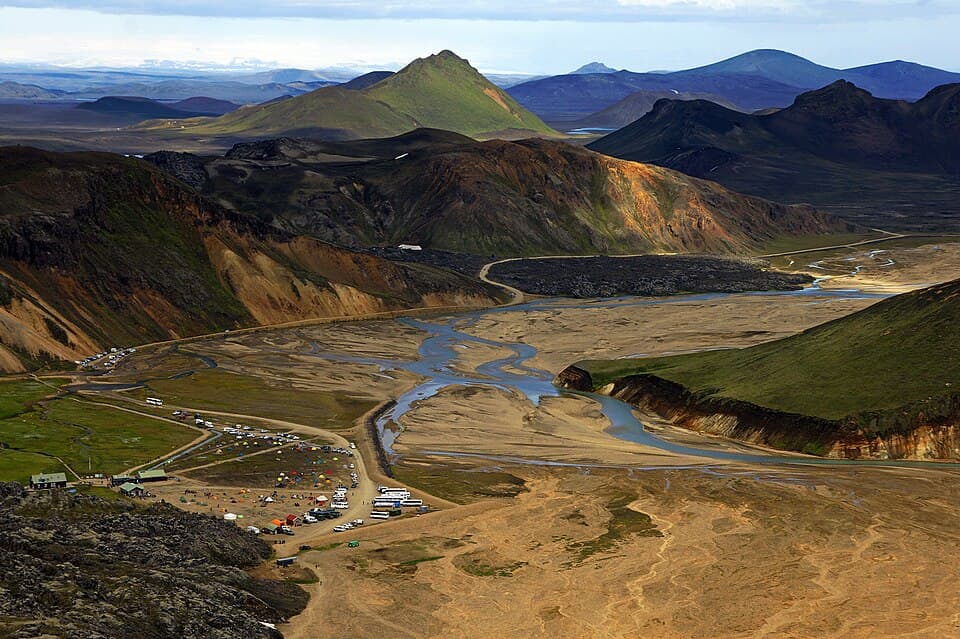
Many F-roads cross rivers, and often there is no bridge. You drive through the water itself, and the depth and flow change through the day: a glacial river that is a shallow trickle at 8am can be a fast, thigh-deep hazard by afternoon once the sun has been working on the ice upstream. This is the single most common way rental 4WDs are written off — and the way people get into genuine danger.
The rules are non-negotiable. Only cross in a vehicle rated for it — a super-jeep or a full Highland truck, not a soft crossover. Scout every ford on foot first, walk it to judge the depth and the current, and never cross alone in a single car. If a crossing looks wrong, turn around; there is no shortcut worth a swamped engine in the middle of nowhere. SafeTravel publishes detailed river-crossing guidance — read it before any interior trip, and check live conditions on our alerts page first.
The passes, right now
Live frames from the mountain passes and highland-edge crossings that decide whether today is an F-road day. If a pass looks white, the interior beyond it usually is too.
 Live
Live Live
Live Live
Live Live
LiveA clear pass on camera doesn't guarantee an open F-road behind it — but a snowed-in one is a straight answer. Pair these frames with the live status line at the top and the road-conditions feeds before you commit. Our pre-drive checklist walks through the exact order to check them in.
Why F-roads are only open in summer
The interior sits high and exposed, and it holds snow long after the coast has thawed. F-roads open only once the snow has melted enough for the surface to bear traffic and for the river fords to drop to a crossable level — and they close again in autumn when the weather turns. Most open sometime in June, a few of the hardest not until late June or early July, and they shut through September and October.
Because the melt is different every year, there is no calendar you can trust. Do not assume a road is open just because it is July. The live F-roads hub shows which mountain roads are currently open, and outside summer the whole network is shut — if you are travelling then, our winter driving guide covers what you can still do. Fill your tank before you leave the coast, too: there are no gas stations once you are on the interior F-roads.
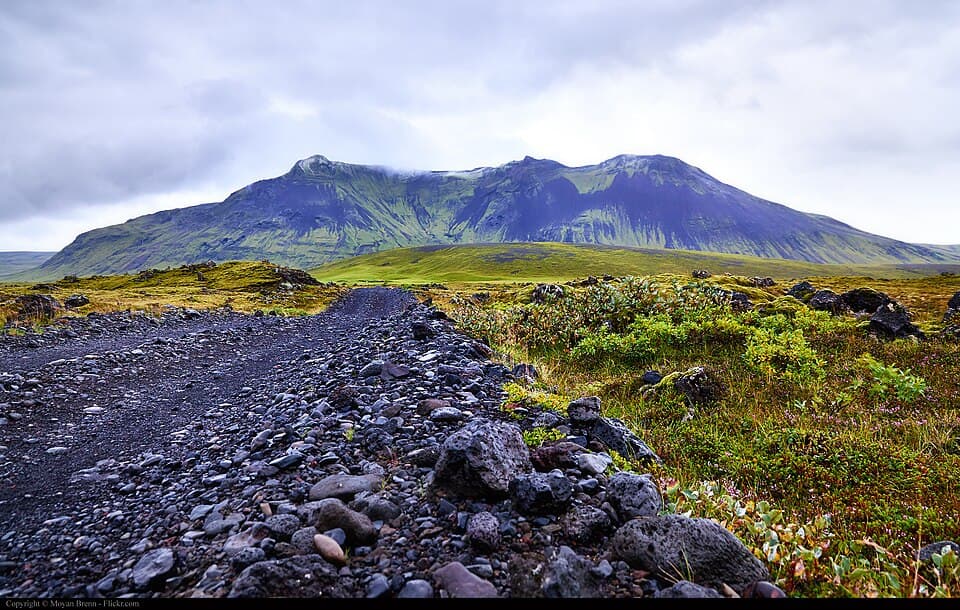
Four F-roads, from easiest to hardest
“F-road” covers everything from a graded track a small 4x4 handles to a two-day interior crossing for experienced drivers only. These four, in order, show the range. See the full network on the F-roads hub, or the pick of them in best F-roads in Iceland.
#1.F35 Kjalvegur — the gentle introduction
length: 168 kmdifficulty: easyminimum vehicle: any 4x4
F35 Kjalvegur (Kjölur) runs across the interior between the Golden Circle and the north. Its major rivers are bridged, the data rates it easy, and any 4x4 can drive it — which makes it the usual first F-road. A Dacia Duster or Hyundai Tucson is plenty here.
#2.F208 Fjallabaksleið nyrðri — the Landmannalaugar road
difficulty: variesminimum vehicle: any 4x4 north / medium 4x4 southhazard: river crossings
F208 is the road most people mean when they say they are driving to Landmannalaugar. The northern half is manageable in any 4x4; the southern half is harder and has fords, so it wants a medium 4x4 and more care. It is the step up from F35 — a real F-road experience without the extremes.
#3.F26 Sprengisandsleið — the great interior crossing
length: 200 kmdifficulty: hardminimum vehicle: large 4x4
F26 Sprengisandur runs 200 km straight through the middle of the country, between the northern and southern lowlands. It is rated hard, needs a large 4x4, and crosses long stretches of empty desert with unbridged rivers and no services. This is a serious day's driving for prepared travellers — step up to a Land Cruiser.
#4.F249 Þórsmerkurvegur — super jeep only
difficulty: extrememinimum vehicle: super jeep onlyhazard: deep fords (Krossá)
F249 into Þórsmörk is rated extreme — the data lists it as super-jeep only, because of deep, fast river crossings that catch out even large 4x4s. Most travellers reach Þórsmörk on a highland bus or an organised super-jeep tour rather than a rental. If you are asking whether your car can do F249, the answer is almost certainly no.
Frequently
asked questions
What does the F in F-road mean?
Do I legally need a 4WD to drive F-roads in Iceland?
What's the difference between an F-road and a normal gravel road?
Are there rivers to cross on F-roads?
When do F-roads open and close?
Can I drive F-roads in a camper?
Which is the easiest F-road for a first-timer?
What happens if I get caught on an F-road in a 2WD?
Cars & campers
 KEF airport pickup 24/74.8
 Transmission
 Fuel
Fuel Seats
Seats Drive
Drive

 Sleeps
Tours near Iceland's highlands
 Small groups
 Duration
 Highlights
 Type
Type