Blue Lagoon map and directions
It is closer to the airport than to Reykjavík, and that one fact decides when you should go. Here it is on the map, with the drive from everywhere you might start.
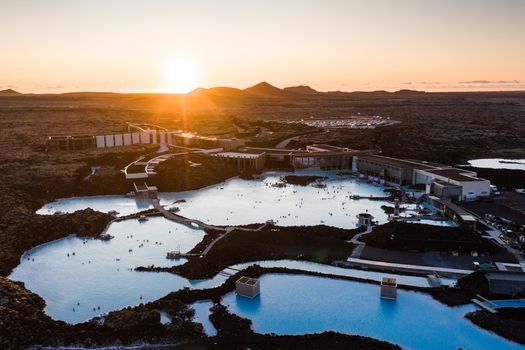
The Blue Lagoon sits in a lava field beside the Svartsengi power station on the Reykjanes peninsula, roughly 20 km by road from Keflavík Airport and 45 km from central Reykjavík. That is a 20–25 min drive from the terminal against 45–50 min from the city, so it belongs on your arrival or departure day rather than in the middle of a Reykjavík stay. Entry is by pre-booked time slot — walk-ins are not accepted.
Ring Road (R1) slippery in placesHighlands: 16 of 66 monitored roads closed or impassableVegagerðin, updated just now
The Blue Lagoon on the Reykjanes peninsula
Our own coordinate for the lagoon, on the interactive map — pan out for the airport, Grindavík and the road in.
| Starting from | By road | Straight line | Drive | Roads | Worth knowing |
|---|---|---|---|---|---|
| Keflavík Airport (KEF) | ≈20 km | 14 km | 20–25 min | Route 41 then 43 | The reason to go here at all — bathe between the plane and the city. |
| Central Reykjavík | ≈45 km | 39 km | 45–50 min | Reykjanesbraut (41) then 43 | No public bus. Drive, or take a scheduled transfer coach. |
| Grindavík | ≈5 km | 4 km | 8–10 min | Route 43 | The nearest town. Road access here has changed repeatedly since 2023 — check before relying on it. |
Two distance columns, because they answer different questions and most pages quietly mix them up. By road is the approximate driving distance — the airport and Grindavík figures are the ones recorded against the lagoon in our own POI data, and they are the numbers you will see elsewhere. Straight line is computed from the lagoon’s coordinates to each origin, which is why it is consistently shorter: the road bends around the lava. Neither is a routed measurement, so both are given as approximations rather than to a false decimal.
The drive column is a range for these roads in normal conditions. We give a range because we hold coordinates, not live routing — an invented “23 minutes” would be worse than an honest “20–25”. Wind and winter both push the real figure up, sometimes a long way.
The drive, and why the road matters more here than elsewhere
From the airport you leave on Route 41, the Reykjanesbraut, and turn south onto Route 43 towards Grindavík; the lagoon is signposted off it before the town. From Reykjavík it is the same road in the other direction — the Reykjanesbraut the whole way, then the same turn-off. Both are paved, two-lane and completely straightforward in summer.
Reykjanes is the exception to “the drive is easy” for two reasons. The first is wind: the peninsula is flat, treeless lava, and the Reykjanesbraut is one of the most exposed stretches of road in the southwest — it closes for wind, not for snow. The second is volcanic. Eruptions in the Grindavík area since 2023 have repeatedly changed which roads are open and have closed the lagoon itself more than once.
Neither of those is something a guide page can state as a fact, because both change by the day. Check whether you can drive it today and the live alerts on the morning you go, and check the operator’s own status before you set off. It is worth having a second lagoon in mind — Sky Lagoon is inside the city and unaffected by anything happening on Reykjanes.
If you are not driving, there is no public bus. Scheduled transfer coaches run from Reykjavík and from the airport, and private transfers do the same door to door — see transfers and tours. If you are driving, the airport road guide covers the same stretch in detail.
The entry rules that catch visitors out
You must book a time slot. Entry is timed and pre-booked, and walk-ins are not accepted — arriving on spec is the most common way people waste the drive out. Book first, then plan the day around the slot rather than the other way round.
You must shower naked, with soap, before you get in. This is the rule visitors find surprising and Icelanders find non-negotiable, and it applies at every pool and lagoon in the country. Icelandic pools run on very little chlorine; the shower is what keeps the water clean, and attendants do enforce it. Our etiquette guide covers the full set of unwritten rules.
Put conditioner on your hair and tie it up. The silica that makes the water milky-blue also bonds to hair and leaves it stiff for days. Leave-in conditioner is provided in the showers — use more than feels reasonable, and keep long hair out of the water. On skin the same mineral is harmless; it is what the white mud mask is made of.
Bring or rent a towel, and use the luggage store. Towels are included in some packages and not others. There is luggage storage on site precisely because so many visitors come straight from or head straight to a flight — which, given it is a 20–25 min drive from the terminal, is the sensible way to use the place.
Frequently
asked questions
Where is the Blue Lagoon in Iceland?
How far is the Blue Lagoon from Keflavík Airport?
How do I get from Reykjavík to the Blue Lagoon?
Is the Blue Lagoon walking distance from the airport?
Do you have to book the Blue Lagoon in advance?
Do you have to shower naked before the Blue Lagoon?
Why do they tell you to put conditioner on your hair?
Is the Blue Lagoon affected by the Reykjanes eruptions?
Cars & campers
 KEF airport pickup 24/74.8
 Transmission
 Fuel
Fuel Seats
Seats Drive
Drive

 Sleeps
Tours near Blue Lagoon
 Small groups
 Duration
 Highlights
 Type
Type