
Puffin Season in Iceland
They arrive around the turn of April and May, and they are gone by roughly mid-August. That is the whole answer — the rest of this page is where to stand while they are still here.
Puffins are in Iceland from about mid-April to mid-August, then they leave for the open sea until spring. Vísindavefurinn puts the young birds' departure at around the middle of August. So in mid-July you have roughly four weeks left — and the adults are at their busiest, ferrying fish to the burrow.
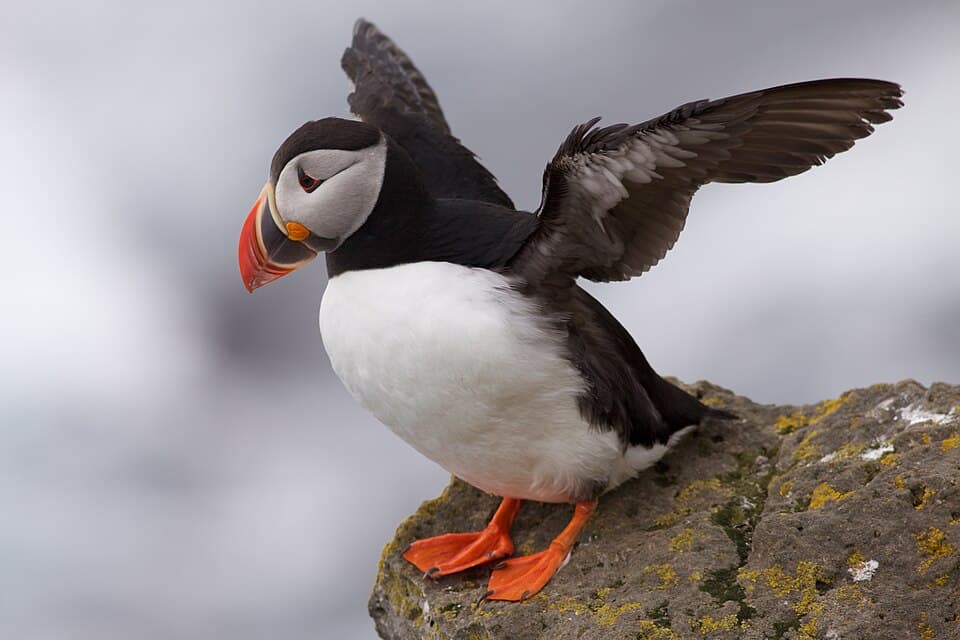
The puffin is the most common breeding bird in Iceland. The Icelandic Institute of Natural History puts the population at around 2 million pairs, and Fuglavernd — BirdLife's Icelandic partner — reckons that is about 40% of every Atlantic puffin alive. You will see a bigger number quoted elsewhere. We are using the one the ornithologists publish.
They are also, quietly, in trouble. The same institute listed the puffin as Critically Endangered on the Icelandic Red List in 2018, after a decline of roughly 3% a year since 1998. A bird can be everywhere and still be going. That is worth holding in your head while you stand on a clifftop watching thousands of them: this is not a permanent fixture.
| Colony | Region | When | Getting there | 4WD? | Pairs |
|---|---|---|---|---|---|
| Vestmannaeyjar (Heimaey) | South | To mid-Aug; pufflings late Aug–early Sep | Ferry from Landeyjahöfn, or fly | No car needed | 840,375 (2015) — 41.5% of Iceland |
| Látrabjarg | Westfjords | Mid-Apr to mid-Aug | Drive — road 612 | No 4WD needed | 50,000 (2000) |
| Hafnarhólmi | East · Borgarfjörður eystri | Mid-Apr to mid-Aug; peak from May | Drive, or the weekday bus from Egilsstaðir | No car needed | 8,000–10,000 |
| Dyrhólaey | South | Mid-Apr to mid-Aug; may close 1 May – 25 Jun | Drive — off the Ring Road near Vík | No 4WD needed | Not published — below the census threshold |
| Grímsey | North · Arctic Circle | Mid-Apr to mid-Aug | Ferry (Sæfari, from Dalvík) or fly from Akureyri | No car needed | 40,275 (2015) |
| Ingólfshöfði | Southeast · Öræfi | Tour runs early May to mid-Aug | Tractor-drawn hay cart, 7 km across the sands | You can't drive at all | Not published — below the census threshold |
Pair counts come from the Institute of Natural History's census of internationally important colonies, with the survey year attached, because a seabird count from 2000 and one from 2015 are not the same claim. Dyrhólaey and Ingólfshöfði have no published figure because they fall below that census's threshold — they are real colonies, just not big ones, and we would rather say so than invent a number.
Three of Iceland's biggest colonies are missing from this table on purpose. Breiðafjörður, Skrúður and Papey are all larger than Látrabjarg, and none of them has a scheduled way for a visitor to arrive. A row that cannot answer “how do I get there” is not a row.
Conditions at the colonies right now
Wind first, because that is the number that decides your day here. Every colony on this page is either an unfenced clifftop or a boat ride, and a 20 m/s gust makes the first dangerous and cancels the second. Readings are taken at each colony's own coordinates — the Látrabjarg clifftop, not the nearest village.
- LátrabjargWestfjords · 14 km of unfenced clifftop
wind11m/s(gusts 15)8°COvercastvisibility40km
- HeimaeyVestmannaeyjar · the largest colony, reached by ferry
wind8m/s(gusts 12)8°COvercastvisibility35km
- HafnarhólmiBorgarfjörður eystri · the viewing platform
wind8m/s(gusts 11)4°COvercastvisibility42km
- GrímseyNorth · Arctic Circle island, 3 h by ferry
wind8m/s(gusts 11)6°CMostly clearvisibility37km
- IngólfshöfðiSoutheast · reached only by tractor across the sands
wind7m/s(gusts 9)3°CClear skyvisibility34km
Open-Meteo, updated just now · readings taken at each colony's own coordinates, not the nearest town. Weather only — nobody can tell you from a forecast whether the birds are sitting out today.
They are not all on the way to each other
Látrabjarg sits at the far west of the Westfjords, Borgarfjörður eystri at the far east, Grímsey on the Arctic Circle, and Vestmannaeyjar out to sea off the south coast. Only Dyrhólaey is genuinely on the Ring Road. Open the map to see how far apart the good ones really are.
The calendar, and why mid-August is the wall
Puffins keep a tight schedule. They appear at the colonies around the turn of April and May, according to Vísindavefurinn, the University of Iceland's science service; Borgarfjörður eystri, which runs the Hafnarhólmi colony, puts the national window as the beginning of April until September. Then a single egg goes into a burrow — laid late May into early June — and everything after that is arithmetic.
The egg takes about 42 days to hatch. The chick then sits underground for roughly another 40 to 45 days while both parents fly fish in to it. Add those together from a late-May laying and you land in the second half of August, which is exactly what Vísindavefurinn says: around the middle of August, the young bird leaves the nest. Once the chick goes, the adults have no reason to stay either. By September the cliffs are empty and the birds are somewhere out in the North Atlantic, not touching land again until spring.
Which makes mid-July — right now — close to the best time to be standing at a colony, and not because of anything scenic. It is because the chick is in the burrow and hungry, so the adults are commuting all day with beaks full of fish. Come in early May and the birds are there but quieter. Come in September and you have driven four hours to look at grass.
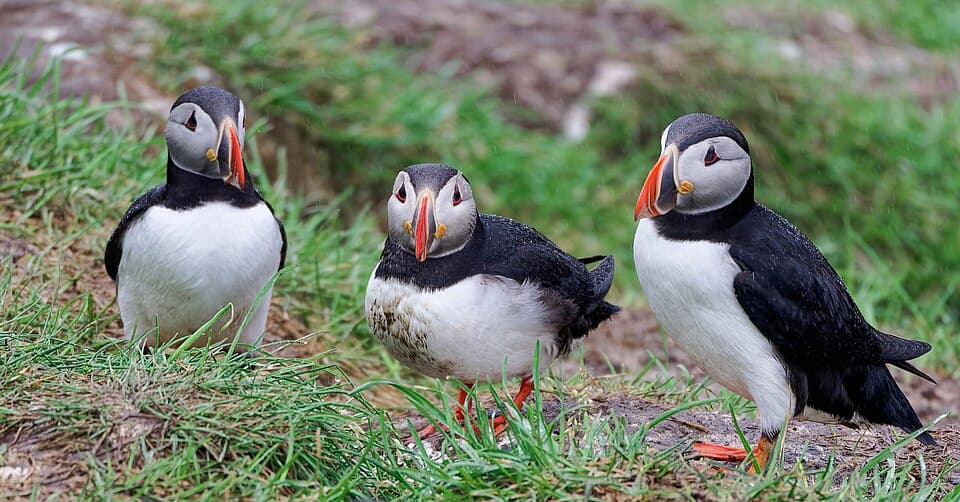
They live in the grass, not on the rock
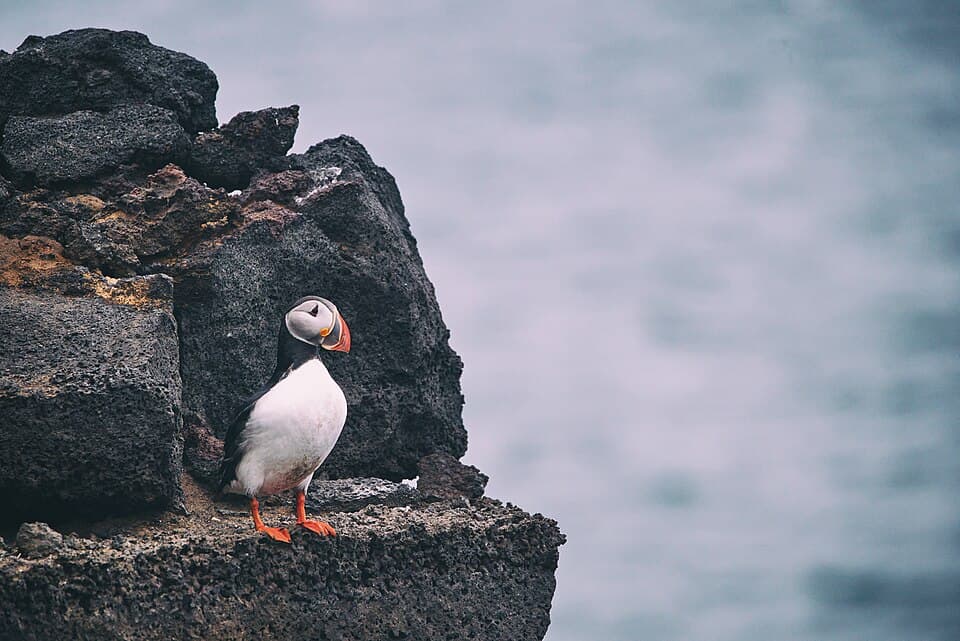
This is the thing people get wrong before they arrive, and it matters for both your photos and your safety. Puffins do not perch on ledges like guillemots. They dig — a burrow up to half a metre into the turf, per Borgarfjörður eystri — and they dig it in the soft grassy soil along the top of the cliff. Visit Westfjords says the same of Látrabjarg: the puffins are the ones frequenting the grassy, higher part of the cliffs.
So the birds are at your feet, not below you. That is why puffin photos look so intimate compared with every other seabird, and it is also why the ground you are standing on near a colony is honeycombed with tunnels and weaker than it looks.
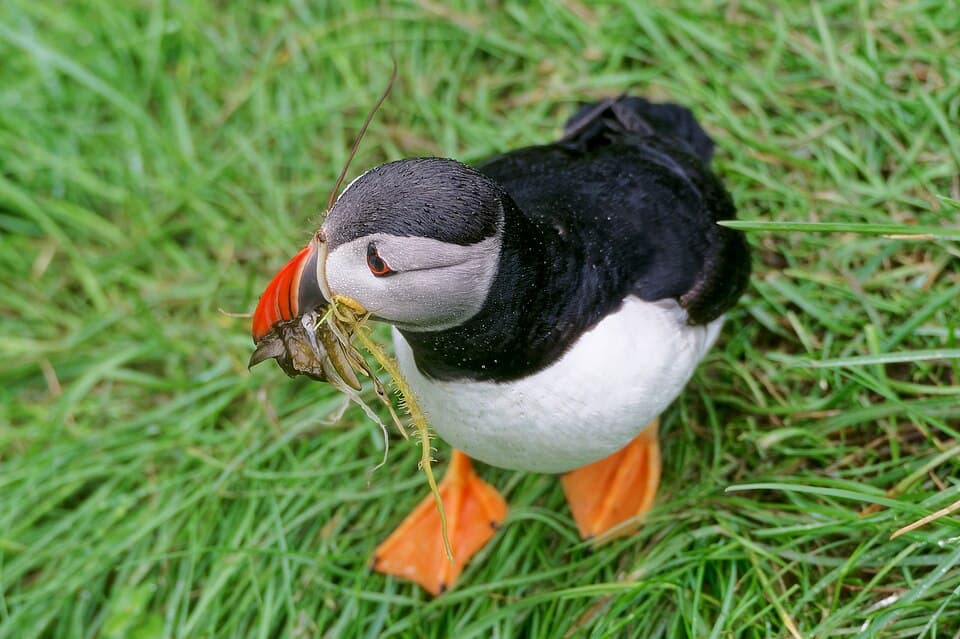
The cliff edge is the real hazard
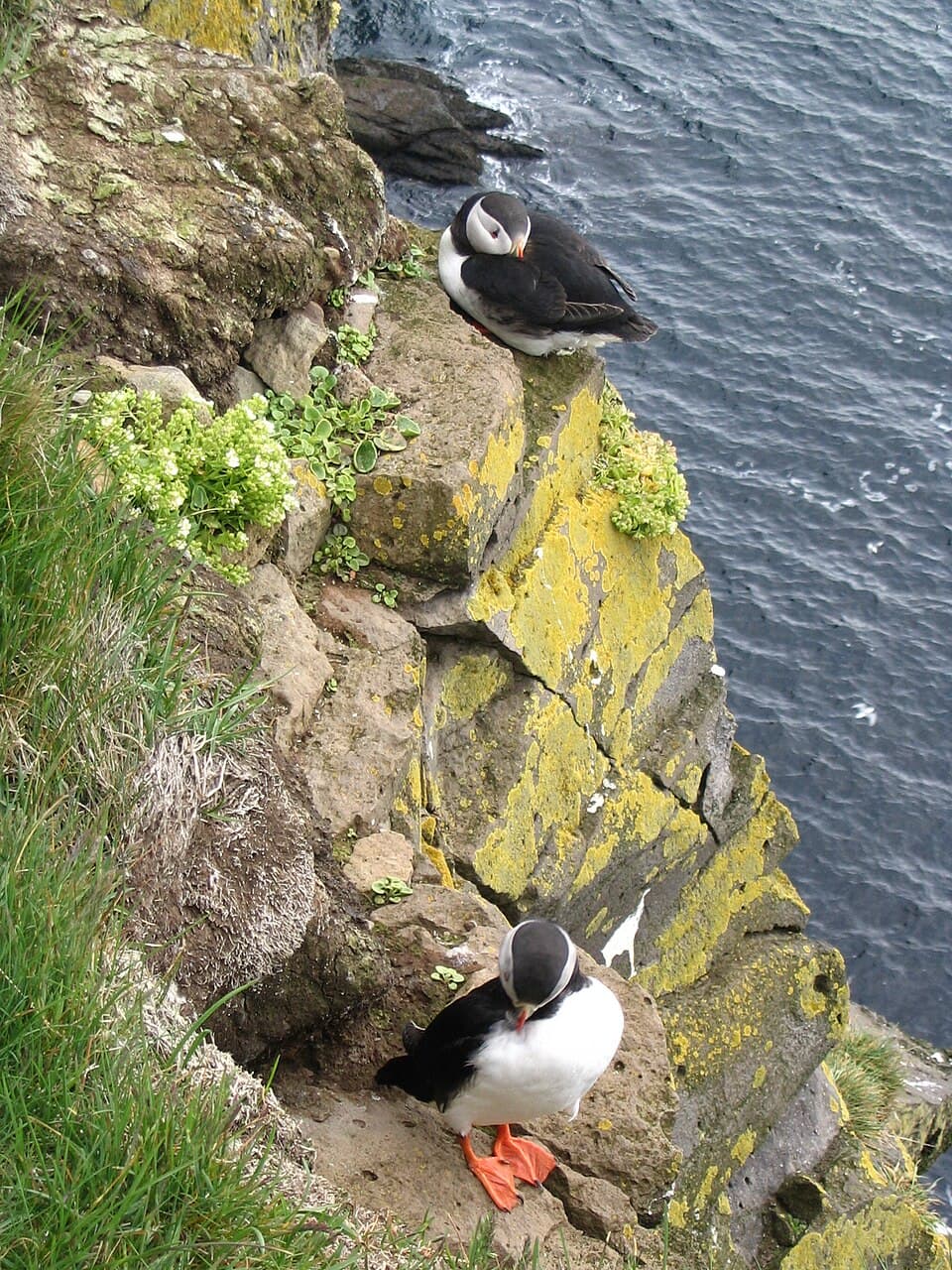
Látrabjarg is 14 km of cliff, up to 441 m high, and Visit Westfjords — the region's own tourist board — describes it in seven words: “the edges are fragile and loose and the fall is high”. There is no fence and no rail along it.
The mechanism is specific, and it is the same one that makes the birds so photogenic. The puffins nest in the turf at the lip. To photograph a puffin you move toward the lip. The lip is undercut, riddled with burrows, and sitting on top of a drop you cannot see the bottom of. People do not fall because they are reckless — they fall because they took one more step toward a bird that was not going to fly away.
Iceland's nature agency documents the same failure at Dyrhólaey: the path between Lágey and Háey had to be moved away from the cliff edge because it had cracked in places and could collapse with little or no warning. Keep well back from any edge, do not sit on an overhang for a photo, and check the live wind figures above before you go anywhere near one — a gust is what turns a bad position into a fall. If you want to be genuinely close to a puffin without any of this, go to Hafnarhólmi, where the platform does the job for you.
The puffling patrol
This is the best thing in this guide, and it happens in the last three weeks of the season. In Heimaey, young puffins leave the burrow at night and navigate to the sea. Except Heimaey is a town, and a town has lights. Some of the pufflings go the wrong way and end up flapping around a car park instead of the North Atlantic.
So the town goes and gets them. After dark, families walk the streets with torches and cardboard boxes, collecting stranded chicks, and in the morning the birds go to the Puffin Rescue Centre on the island — run by the Sea Life Trust — to be checked and released. Science News reports that the 2024 season turned up more than 4,200 pufflings — more birds rescued than the island has residents. It has been going on far longer than the catchy name has.
The window is late August into early September, when Science News says the pufflings are mature enough to go and head out over four or five weeks. If your trip lands in that window and you can get to Vestmannaeyjar, it is the one puffin experience in Iceland you cannot have anywhere else — and the one where the birds are better off for you having turned up.
Which colony should you actually go to?
Four honest answers, depending on what your trip already looks like. Compare them against the live wind readings above before you commit to a long drive.
#1.You want the most puffins: Vestmannaeyjar
colony size: 840,375 pairs (2015)share: 41.5% of Icelandaccess: ferry or flight
No contest on numbers — 41.5% of every puffin pair in Iceland is on this one archipelago, and Vísindavefurinn calls them the largest colonies in the world. Take the Herjólfur ferry from Landeyjahöfn or fly. You can walk on without a car, which makes this the rare Icelandic destination where renting nothing is the right call. Come in late August and you get the puffling patrol too.
#2.You want to be close, safely: Hafnarhólmi
colony size: 8,000–10,000 pairsfacilities: shelter + platformsregion: East, via Egilsstaðir
Borgarfjörður eystri built a shelter and wooden platforms so you can get close “without the risk of falling into a burrow or down a cliff”. That is the whole pitch, and it is a good one — it is the only colony here where the infrastructure removes the hazard instead of asking you to manage it. Best with kids, best in bad weather, and reachable on the weekday bus from Egilsstaðir if you would rather not drive.
#3.You are already going to the Westfjords: Látrabjarg
colony size: 50,000 pairs (2000)height: up to 441 m of cliffaccess: road 612, any car
Fewer birds than the census-toppers, but the experience is unmatched: 14 km of cliff and puffins that will let you sit down beside them. Road 612 gets you there and Visit Westfjords says the cliffs are easily accessible by car — a small 2WD is enough, though a crossover is more comfortable on the Westfjords gravel generally. Read the cliff-edge section above before you go. Twice.
#4.You only have a Ring Road day: Dyrhólaey
time: a detour, not a dayrestriction: may close 1 May – 25 Junaccess: straight off Route 1
The convenient one, not the big one — it is too small to make the Institute of Natural History's list of internationally important colonies, and we are not going to pretend otherwise. What it has is position: it is right there near Vík, on the drive you were doing anyway. One catch — the nature agency can restrict visits between 1 May and 25 June for the birds, and an ornithologist decides year by year whether it is needed. Check before you turn off; do not trust a blog that prints fixed dates.
The two that ask more of you
Grímsey holds 40,275 pairs and sits on the Arctic Circle, three hours from Dalvík on the Sæfari — the ferry the Road Administration runs — or a short flight from Akureyri. It costs you a day and gives you a latitude line as a souvenir.
Ingólfshöfði is the strangest of the six. It is a nature reserve on a headland 9 km off the Ring Road, and Iceland's nature agency is blunt about the route: it is only passable for off-road vehicles and tractors, and it asks visitors not to drive out there in their own cars. So you cross the sands in a tractor-drawn hay cart, about half an hour each way, and then a guide walks you 2–3 km around the cape. Not for a tight schedule. Excellent for everyone else.
And if you are stuck in Reykjavík with an afternoon: there are colonies on the harbour islands, Akurey among them, reached by boat. We have no published pair count for them, so we will not invent one — but they are real puffins, fifteen minutes from a coffee.
Frequently
asked questions
When do puffins leave Iceland?
Is mid-July too late to see puffins in Iceland?
When do puffins arrive in Iceland?
Where is the best place to see puffins in Iceland?
Do I need a 4WD to see puffins in Iceland?
How many puffins are there in Iceland?
What is the puffling patrol?
Is Dyrhólaey closed during puffin season?
Getting to the cliffs
Puffins are the rare Icelandic attraction that does not argue for a big car. None of these colonies is on an F-road, so none of them needs a 4WD by law — see the 4WD guide for where that changes. Two of the best (Vestmannaeyjar, Grímsey) are reached by boat or plane, and one (Ingólfshöfði) actively asks you to leave the car behind. For everything else, a small 2WD does it; the Westfjords gravel to Látrabjarg is more pleasant in a crossover. Check the alerts page for weather and road status before a long drive west or east, and see summer driving in Iceland for what the roads themselves are like.
Cars & campers
 KEF airport pickup 24/74.8
 Transmission
 Fuel
Fuel Seats
Seats Drive
Drive

 Sleeps
Tours near Iceland's puffin colonies
 Small groups
 Duration
 Highlights
 Type
Type