
What a Campervan Trip in Iceland Costs
Rental, fuel, the kilometre fee and campsites — broken out by camper class and trip length, with an interactive calculator.
A campervan trip in Iceland costs roughly your rental (per night, by camper class), fuel (distance ÷ economy × pump price), the per-km kilometre fee, and campsite fees (~1,500–2,500 ISK per adult per night). The calculator below estimates all four. For a 7–10 night loop, a camper is often cheaper than a car plus hotels.
How much does fuel cost in Iceland today?
Petrol (95 octane) averages 278.8 ISK per litre across Iceland today, ranging from 241.2 to 287.4 ISK/L — the cheapest station right now is Kauptún (Costco Iceland) at 241.2 ISK/L.
Data verified 16 October 2026, 04:57 · source: gasvaktin.is · refreshes with station price changes
Ring Road (R1) openHighlands: 56 of 64 monitored roads closed or impassableVegagerðin, updated just now

The loop your budget is built on
Most campervan trips follow Route 1 around the country. Total distance drives both your fuel and your kilometre fee — open the map to plan the loop and find campsites along it.
Campervan cost calculator
A budgeting estimate — not a quote. Set your trip, pick a camper class, and see the rental, fuel, kilometre fee and campsite costs broken out.
- Rental (7 nights)84,000–154,000 ISK7 × 12,000–22,000 ISK/night
- Fuel38,400 ISK120 L (1,500 km ÷ 100 × 8 L) × 320 ISK/L
- Kilometre fee10,425 ISK1,500 km × 6.95 ISK/km
- Campsites (2 adults)21,000–35,000 ISK7 nights × 2 × 1,500–2,500 ISK
Every figure here is an estimate for budgeting, not a quote — book for the real number. Rental, fuel and campsite fees are typical 2026 summer ranges that move with season, company and lead time. The kilometre fee is exact (6.95 ISK/km, a road charge that appears as a line item during booking, not in the headline daily rate — see the kilometre-fee guide). Ranges last checked 2026-07-08. This excludes food, tolls (Iceland has one: the Vaðlaheiðargöng tunnel), and any extras like a second driver or gravel protection.
The four things that set the price
A campervan bill is easier to reason about than it looks, because almost all of it comes down to four line items. Get a feel for each and you can budget a trip in your head.
- Rental, per night. The biggest single cost, and it swings most with camper class and season. A compact 2-berth is cheapest; a 4x4 rooftent costs more because you're paying for the four-wheel drive and the gravel capability. Nights × the nightly rate is the bulk of your total.
- Fuel. Distance ÷ fuel economy × pump price. A bigger van burns more per 100 km, and Iceland's pump prices are high and change often. This is why total km matters as much as nights — a slow loop with lots of driving can cost more in fuel than in extra rental days.
- The kilometre fee. A per-kilometre road charge that applies to every vehicle, camper included. It's exact, it scales straight with distance, and it appears as a line item during booking, not in the headline daily rate. Full detail is in the kilometre-fee guide — this page just plugs the current rate into your total.
- Campsites. Per adult, per night, usually around 1,500–2,500 ISK at Icelandic campsites in summer. Low next to a hotel, but it adds up across a long trip — and, importantly, it's not optional (see below).
You can't wild camp for free in a campervan in Iceland. Since 2015, sleeping in a camper, motorhome or tent outside a marked campsite is banned across most of the country. Budget for campsite fees every night — free vehicle camping is not a legal plan, and rangers do enforce it.
Plan your campsite stops the way you plan fuel stops. The campsites hub shows where they are and roughly what they cost, and the interactive map places them along your route.
Why a camper can beat a car plus hotels
A campervan folds two bills into one — your bed and your car — and campsite fees are a fraction of hotel prices. For two people driving the Ring Road over a week or more, that usually comes out cheaper than renting a car and booking hotels each night, especially in peak season when rooms are scarce and dear.
It doesn't always win. On a short trip near Reykjavík the nightly rental premium of a camper can outweigh a few cheap hotel nights, and a group splitting a hotel room dilutes the room cost in a way a camper can't match. The honest answer is: run both through a budget. The calculator above gives you the camper side; compare it against your own hotel plan.
Which camper class fits your trip
Match the class to how far off the tarmac you're going — paying for four-wheel drive you never use is money you could spend on more nights.
- 2-berth compact (like the VW Caddy). Cheapest to rent and to fuel. Fine for two people on the paved Ring Road, Golden Circle and South Coast. Not for gravel-heavy detours.
- 3–4 berth van (like the VW Transporter Camper). More room and more sleeping space, still 2WD, more fuel per 100 km. The comfortable paved-route family choice.
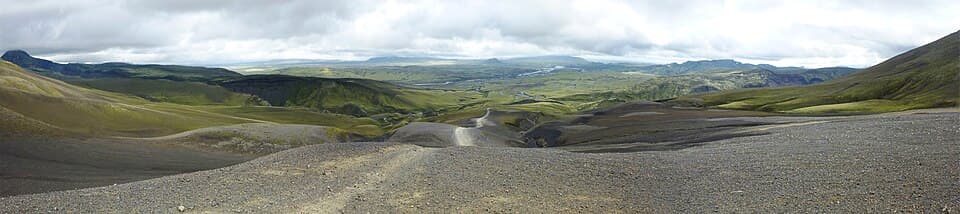
- 4x4 rooftent (like the Dacia Duster Camper 4x4). The only class rated to take gravel and easier summer F-roads. You pay a premium for capability — worth it only if your route actually leaves the tarmac. Not sure? The 4WD guide settles it by route.
For the hardest F-roads and river crossings a rooftent camper isn't enough — that's a Land Cruiser-class job, and few campers are rated for fords. Keep the camper on gravel and easier tracks.
The passes on your loop, right now
Live frames from the mountain passes a Ring Road camper trip crosses. A snowed-in pass in shoulder season can reroute a day — check these before a long driving leg.
 Live
Live Live
Live Live
LiveA camper trip cares about the same crossings a car does. Pair these with the live status line up top and the alerts page before committing to a long driving day — fuel and kilometre-fee costs both scale with the distance you actually end up driving.
What the calculator leaves out
The tool covers the four big drivers, but a real trip has smaller line items on top. Budget a little extra for:
- Food. Groceries from a supermarket are far cheaper than eating out — a camper's kitchen is part of how it saves money.
- The one road toll. Iceland has a single toll road: the Vaðlaheiðargöng tunnel in the north. Everything else is free to drive.
- Extras at booking. A second driver, gravel protection for gravel routes, or a one-way drop-off fee if you don't return to the pickup point.
None of these are large next to rental and fuel, but they're real. Treat the calculator's total as a solid budgeting estimate, then add a buffer for food and any extras you know you'll want.
Frequently
asked questions
Is a campervan cheaper than a car plus hotels in Iceland?
How much does a campervan trip in Iceland cost?
What is the kilometre fee on a campervan?
Can I wild camp for free in a campervan in Iceland?
How much is a campsite in Iceland?
Do I need a 4x4 campervan?
What costs does the calculator leave out?
Cars & campers
 KEF airport pickup 24/74.8
 Transmission
 Fuel
Fuel Seats
Seats Drive
Drive

 Sleeps
Tours near an Iceland campervan trip
 Small groups
 Duration
 Highlights
 Type
Type